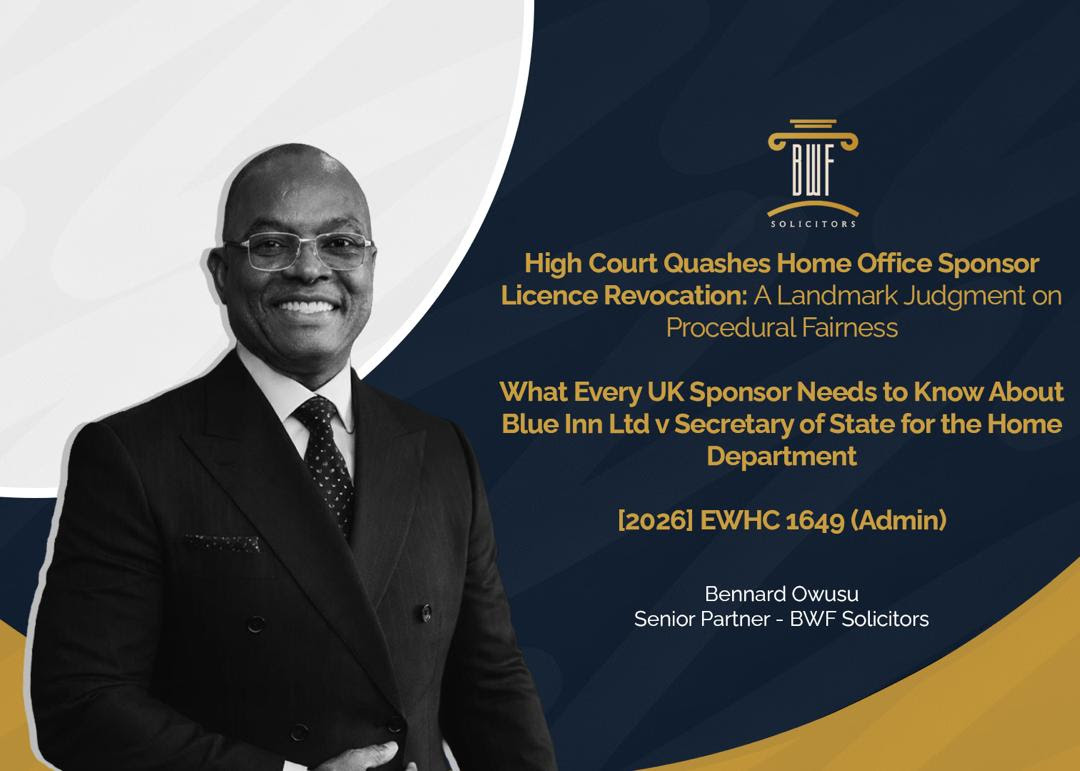
High Court Quashes Home Office Sponsor Licence Revocation: A Landmark Judgment on Procedural Fairness
What Every UK Sponsor Needs to Know About
Blue Inn Ltd v Secretary of State for the Home Department
[2026] EWHC 1649 (Admin)
By BWF Solicitors
The High Court has delivered a significant judgment for UK employers holding Skilled Worker Sponsor Licences, reinforcing an important principle that is sometimes overlooked in Home Office compliance action: although sponsorship is described as “a privilege, not a right”, the Home Office must nevertheless exercise its powers lawfully, fairly and rationally.
In R (on the application of Blue Inn Ltd) v Secretary of State for the Home Department [2026] EWHC 1649 (Admin), the Administrative Court quashed the Home Office’s decision to revoke a sponsor licence after concluding that the decision-making process was procedurally unfair. The judgment provides valuable guidance for employers facing sponsor licence suspensions or revocations and demonstrates that the courts remain willing to intervene where the Home Office fails to follow basic principles of fairness.
R (on the application of Blue Inn Ltd) v Secretary of State for the Home Department [2026] EWHC 1649 (Admin).pdf
For many businesses, particularly those operating within the health and social care, construction, engineering, hospitality and technology sectors, a sponsor licence is not simply an administrative approval. It is a vital commercial asset that enables businesses to recruit skilled overseas workers where suitable resident workers cannot be found. Losing that licence can jeopardise existing contracts, disrupt business operations, result in sponsored workers losing their immigration status and cause significant financial and reputational damage.
The decision in Blue Inn Ltd is therefore one of the most important sponsor licence judgments delivered this year.
The Background
Blue Inn Ltd operated as a construction company and held a Skilled Worker Sponsor Licence issued by the Home Office.
Following an unannounced compliance inspection, Home Office compliance officers raised several concerns regarding the company’s sponsorship arrangements. These included allegations that sponsored workers were being supplied to third parties as labour rather than working under genuine subcontracting arrangements, that certain sponsored roles did not constitute genuine vacancies, and that salary and working hour records did not demonstrate compliance with the conditions attached to the Certificates of Sponsorship (CoS).
R (on the application of Blue Inn Ltd) v Secretary of State for the Home Department [2026] EWHC 1649 (Admin).pdf
The Home Office subsequently suspended the sponsor licence and invited representations.
Blue Inn responded with detailed legal submissions supported by contracts, client correspondence, payroll records, interview notes and additional documentary evidence intended to demonstrate that it retained responsibility for its sponsored workers and that the sponsored vacancies complied with the Home Office Sponsor Guidance.
R (on the application of Blue Inn Ltd) v Secretary of State for the Home Department [2026] EWHC 1649 (Admin).pdf Despite those representations, the Secretary of State revoked the licence.
Blue Inn challenged the decision by way of Judicial Review.
Why the High Court Allowed the Claim
The Court accepted that the Home Office has an important statutory function in maintaining the integrity of the UK’s sponsorship system.
However, that responsibility does not permit unfair decision-making.
A central feature of the judgment was the Court’s finding that once Blue Inn had produced evidence capable of answering the Home Office’s concerns, the Secretary of State was required, in the circumstances of this case, to engage properly with that evidence before reaching a final decision.
Rather than seeking clarification on material issues raised by the sponsor, the Home Office rejected significant documentary evidence and relied upon perceived inconsistencies without undertaking further enquiries that procedural fairness required.
R (on the application of Blue Inn Ltd) v Secretary of State for the Home Department [2026] EWHC 1649 (Admin).pdf
The Court concluded that this rendered the revocation decision unlawful and ordered that it be quashed.
Procedural Fairness Is Not Optional
Perhaps the most significant aspect of the judgment is the Court’s reaffirmation that sponsor licence revocation decisions remain subject to well-established principles of public law.
The Court relied upon important authorities including R v Secretary of State for the Home Department, ex parte Doody [1994] 1 AC 531, R (Balajigari) v Secretary of State for the Home Department [2019] EWCA Civ 673, and R (Prestwick Care Ltd) v Secretary of State for the Home Department [2025] EWCA Civ 184, all of which establish that where a public authority proposes to make findings carrying serious consequences, the affected party must understand the case against it and be given a genuine opportunity to respond before a final decision is reached.
R (on the application of Blue Inn Ltd) v Secretary of State for the Home Department [2026] EWHC 1649 (Admin).pdf
That principle applies with equal force to sponsor licence revocations.
Practical Lessons for Sponsors
The judgment contains several important lessons for employers.
First, sponsors should never assume that a suspension letter inevitably leads to revocation.
Secondly, businesses should ensure that every allegation raised by the Home Office is answered fully with contemporaneous documentary evidence wherever possible.
Thirdly, employers should maintain comprehensive compliance systems
covering contracts, payroll, attendance records, reporting duties and supervision arrangements.
Finally, where procedural fairness has not been observed, Judicial Review may provide an effective remedy.
Our View
At BWF Solicitors, we have successfully represented numerous employers facing sponsor licence suspensions, revocations and compliance investigations.
The Blue Inn judgment is an important reminder that while the Home Office has extensive enforcement powers, those
powers are not unlimited. Sponsors are entitled to expect decisions that are lawful, evidence-based and procedurally fair.
Employers should seek specialist legal advice immediately upon receiving a compliance notice or suspension letter. Early intervention often provides the best opportunity to protect a sponsor licence and the immigration status of sponsored workers.
How BWF Solicitors Can Help
Our business immigration team advises employers throughout the United Kingdom on:
- Sponsor licence applications
- Sponsor licence suspensions
- Sponsor licence revocations
- Home Office compliance visits
- Skilled Worker compliance
- Certificates of Sponsorship (CoS)
- Judicial Review proceedings
- Civil penalties and illegal working investigations
- Immigration compliance audits
If your business has received a Home Office compliance notice or your sponsor licence has been suspended or revoked, contact BWF Solicitors immediately for specialist advice.
Contact BWF Solicitors:
UK: +44 20 8493 7340
Ghana: +233 50 462 2794
Emergency: +44 77 1276 1884
Email: admin@bwfsolicitors.com
Website: www.bwfsolicitors.com
or complete our enquiry form below:
https://bwfsolicitors.com/consultation/
This article provides general information only and does not constitute legal advice. Specific advice should always be obtained based on the individual facts of each case.
About the writer:
Bennard Owusu is an accredited member of the Law Society Family Law Accreditation
Scheme and a member of the Ghana Bar Association. Family Law Accreditation is a
recognised quality standard for family law practitioners in the U.K.