

The cancellation or refusal of a child’s British passport—particularly where one parent is a British citizen—raises serious legal concerns. We are increasingly instructed in cases where the Home Office or HM Passport Office (HMPO) casts doubt on a child’s nationality following a refusal by parents to undertake a voluntary DNA test.
This article explains the legal framework, the limits of DNA evidence, and how such decisions can be effectively challenged.
BACKGROUND: British Citizenship by Descent
Under the British Nationality Act 1981, a child born in the United Kingdom will automatically acquire British citizenship if, at the time of birth:
- The father is a British citizen, and
- The father is recognised as the child’s legal parent under UK law
Where the parents are not married, paternity must be established. However, there is no statutory requirement that paternity be proven by DNA evidence.
THE PROBLEM: DNA Requests and Passport Refusals
In practice, HMPO may:
- Invite parents to attend an interview
- Request further evidence of paternity
- Suggest or invite a DNA test (expressly stated to be voluntary)
Where parents decline DNA testing, decisions are sometimes made to:
- Refuse a passport application, or
- Cancel an already issued British passport
This often occurs when the mother lacks lawful immigration status, which heightens scrutiny. However, a parent’s immigration status is legally irrelevant to a child’s entitlement to British citizenship.
KEY LEGAL PRINCIPLE: DNA Evidence Is Not Mandatory
Home Office policy is clear:
- DNA testing must never be required as a condition of establishing nationality
- Caseworkers must consider all available evidence
- Applicants must not be disadvantaged for refusing DNA testing
This is reflected in official nationality and passport policy guidance, which confirms:
DNA evidence is voluntary and should be used only when other evidence is insufficient.
Accordingly, a refusal or cancellation based solely—or primarily—on the absence of DNA evidence is legally vulnerable.
RELEVANT CASE LAW
The courts have consistently reinforced the principle that decision-makers must act lawfully, rationally, and proportionately when assessing nationality:
- In R (Johnson) v Secretary of State for the Home Department, the Supreme Court emphasised the fundamental importance of British citizenship and the need for fairness in nationality decisions
- In R (Hysaj) v Secretary of State for the Home Department, the Court confirmed that deprivation or interference with citizenship must follow strict legal standards
- In MK (A Child) v Secretary of State for the Home Department, the Court of Appeal stressed that decisions affecting children must be evidence-based and procedurally fair
These authorities support the position that:
- Procedural shortcuts cannot undermine citizenship
- Decisions must be based on all relevant evidence, not a single missing element
- The best interests of the child must be a primary consideration
HOME OFFICE & HMPO GUIDANCE: What Must Be Considered
Both the Home Office and HMPO are bound by their own published guidance, which requires:
- Consideration of birth certificates, naming the father
- Evidence of parental relationship and responsibility
- Documentary proof such as:
- Financial support records
- Communication evidence
- Witness statements
- Medical or school records
Crucially, guidance confirms:
- DNA is supporting evidence, not determinative
- Refusal to provide DNA does not negate other credible evidence
- Decision-makers must apply a holistic evidential assessment
Failure to follow this guidance renders a decision unlawful and subject to challenge.
How to Challenge a Passport Refusal or Cancellation
Where a child’s British nationality is disputed, the following legal avenues are available:
- Administrative Review / Reconsideration
Submit detailed legal representations addressing:
- The statutory framework under the British Nationality Act 1981
- Misapplication of policy on DNA evidence
- The sufficiency of alternative evidence
- Pre-Action Protocol (Judicial Review)
Where reconsideration fails, a Pre-Action Protocol letter can be issued, challenging:
- Irrational reliance on the absence of DNA evidence
- Failure to follow published guidance
- Breach of procedural fairness
- Disproportionate interference with citizenship rights
- Judicial Review Proceedings
If necessary, proceedings can be issued in the High Court seeking:
- Quashing of the decision
- A declaration recognising the child’s British citizenship
- An order requiring reconsideration in accordance with the law
Strategic Considerations
Successful challenges often hinge on:
- Strong evidential bundles demonstrating paternity without DNA
- Detailed legal submissions linking evidence to statutory requirements
- Highlighting inconsistencies between the decision and official guidance
- Emphasising the child’s best interests and rights as a British citizen
Key Takeaway
A child’s British nationality cannot be lawfully denied or withdrawn simply because parents decline a voluntary DNA test.
Where a British father exists, and paternity can be established through credible evidence, the law requires that citizenship be recognised—irrespective of the mother’s immigration status.
Conclusion
These cases demand careful legal handling. The intersection of nationality law, evidential standards, and administrative discretion creates significant scope for decision-makers’ error.
However, with a structured legal approach grounded in statute, case law, and policy, unlawful refusals and cancellations can be successfully overturned—restoring a child’s rightful status as a British citizen.
For specialist advice on nationality disputes, passport refusals, or judicial review challenges, professional legal assistance should be sought promptly.
UK: +44 20 8493 7340
Ghana: +233 50 462 2794
Emergency: +44 77 1276 1884
Email: admin@bwfsolicitors.com
Website: www.bwfsolicitors.com
or complete our enquiry form below: https://bwfsolicitors.com/consultation/
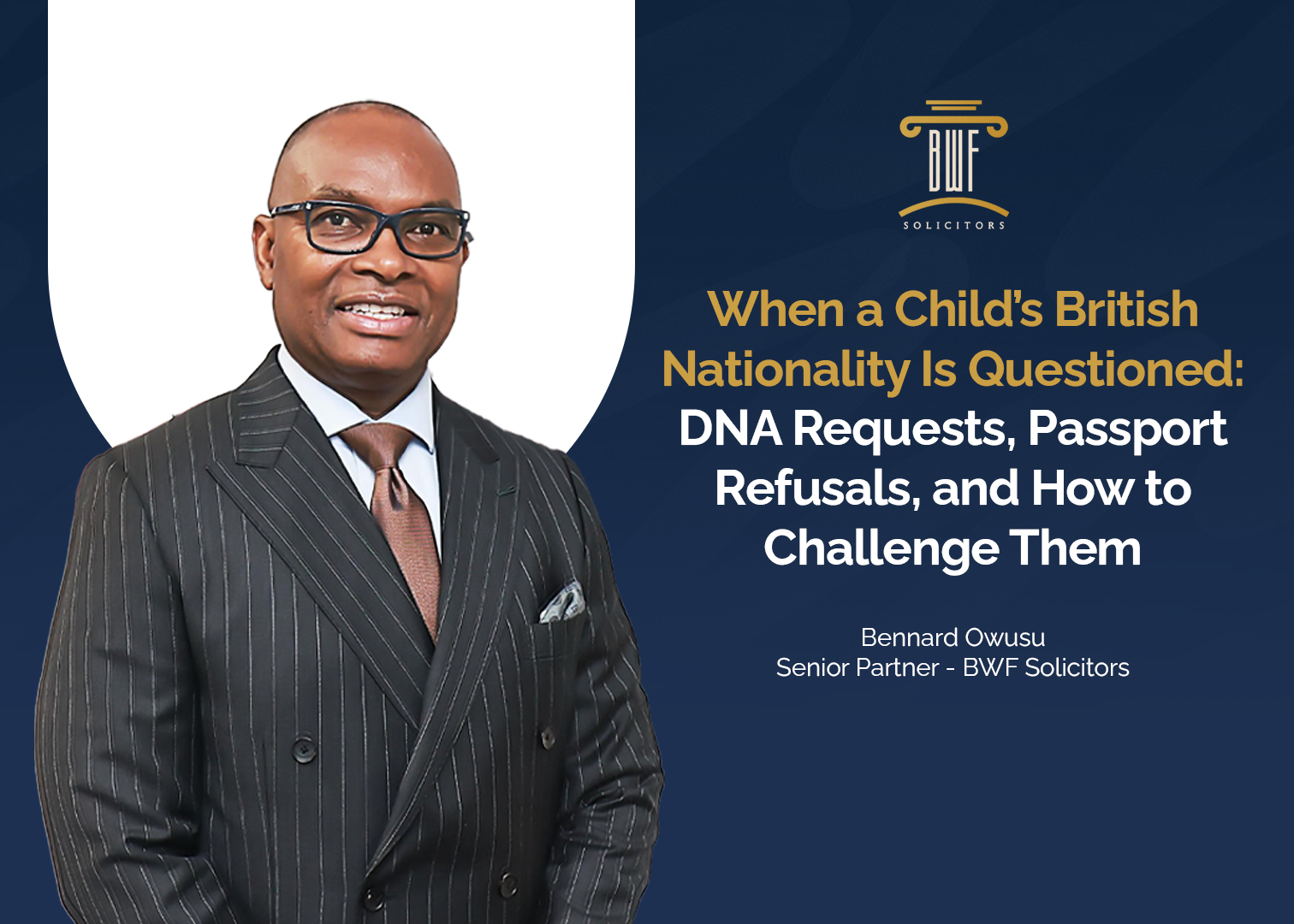
About the writer:
Bennard Owusu is an accredited member of the Law Society Family Law Accreditation Scheme and a member of the Ghana Bar Association. Family Law Accreditation is a recognised quality standard for family law practitioners in the U.K.