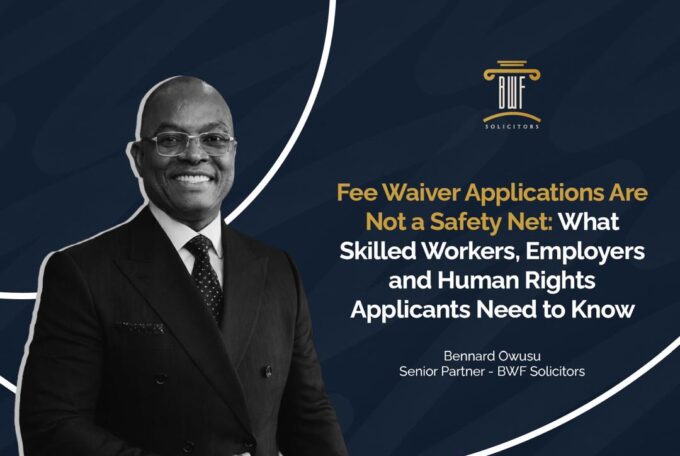

“Fee Waiver Abuse” Is Under Judicial Attack: Why Skilled Workers and Human Rights Applicants Must Now Be Extremely Careful
Introduction
Fee waiver applications have become one of the most important safeguards within the UK immigration system for individuals who genuinely cannot afford Home Office application fees and Immigration Health Surcharge payments. However, recent judicial developments now show that the courts are increasingly scrutinising attempts to use fee waiver applications merely as a mechanism to prolong lawful stay or “buy time” in the United Kingdom.
The Decision in Hussain
The latest Upper Tribunal decision in R (Hussain) v Secretary of State for the Home Department [2026] UKUT 82 (IAC) is a significant warning to applicants and immigration practitioners alike. The Tribunal clarified that repeated fee waiver applications do not automatically preserve lawful immigration status under Section 3C leave.
The Growing Misunderstanding About Fee Waivers
A widespread misconception has developed in recent years that a person can repeatedly submit fee waiver applications in order to extend their stay in the UK while delaying submission of a substantive immigration application. This misunderstanding has particularly emerged in cases involving overstayers, applicants nearing visa expiry, and increasingly Skilled Worker migrants attempting to preserve lawful residence after employment difficulties or sponsorship problems.
What the Home Office Fee Waiver Guidance Actually Says
The Home Office guidance confirms that fee waiver requests are linked to specified human rights-based applications because inability to afford an immigration application may engage Article 8 ECHR rights.
Why This Matters for Skilled Workers
The Skilled Worker route is not itself a human rights route. Accordingly, a fee waiver application by a Skilled Worker often signals that the individual may now be intending to pursue a private life or family life human rights claim outside the normal sponsorship framework. Where Skilled Workers attempt to use fee waiver applications purely to delay departure or preserve lawful residence without a properly arguable human rights basis, they may face loss of Section 3C leave, overstayer status, loss of right to work, sponsor compliance concerns, and future settlement difficulties.
Practical Lessons
Applicants should carefully monitor all Home Office correspondence, seek legal advice immediately following any fee waiver refusal, and ensure substantive applications are filed within the required timeframe. Employers should also ensure that sponsored workers continue to hold valid immigration status to avoid illegal working and sponsor licence risks.
Conclusion
The decision in Hussain represents an important turning point in fee waiver litigation. The Upper Tribunal has made clear that fee waiver applications cannot safely be used simply as a tactical mechanism to prolong lawful residence or delay immigration consequences. For Skilled Workers and other migrants, fee waiver applications must be approached as genuine human rights-based applications rather than temporary holding mechanisms.
Home Office Fee Waiver Guidance
The official Home Office fee waiver guidance can be accessed here: Fee waiver: Human Rights-Based and Other Specified Applications
For professional immigration advice contact BWF Solicitors:
UK: +44 20 8493 7340
Ghana: +233 50 462 2794
Emergency: +44 77 1276 1884
Email: admin@bwfsolicitors.com
Website: www.bwfsolicitors.com
or complete our enquiry form below:

About the writer:
Bennard Owusu is an accredited member of the Law Society Family Law Accreditation
Scheme and a member of the Ghana Bar Association. Family Law Accreditation is a
recognised quality standard for family law practitioners in the U.K.